Highlights
- Most voice agent bugs that sound fine but say the wrong thing start behind the call, in a prompt, a tool or the data.
- Hamming AI is the stronger pick for telephony depth: phone menus, keypad input and load tests of 50K+ concurrent calls.
- Netra covers the whole path: simulated calls, traces, prompt versions and production insights for voice and text agents, with a free plan to start.
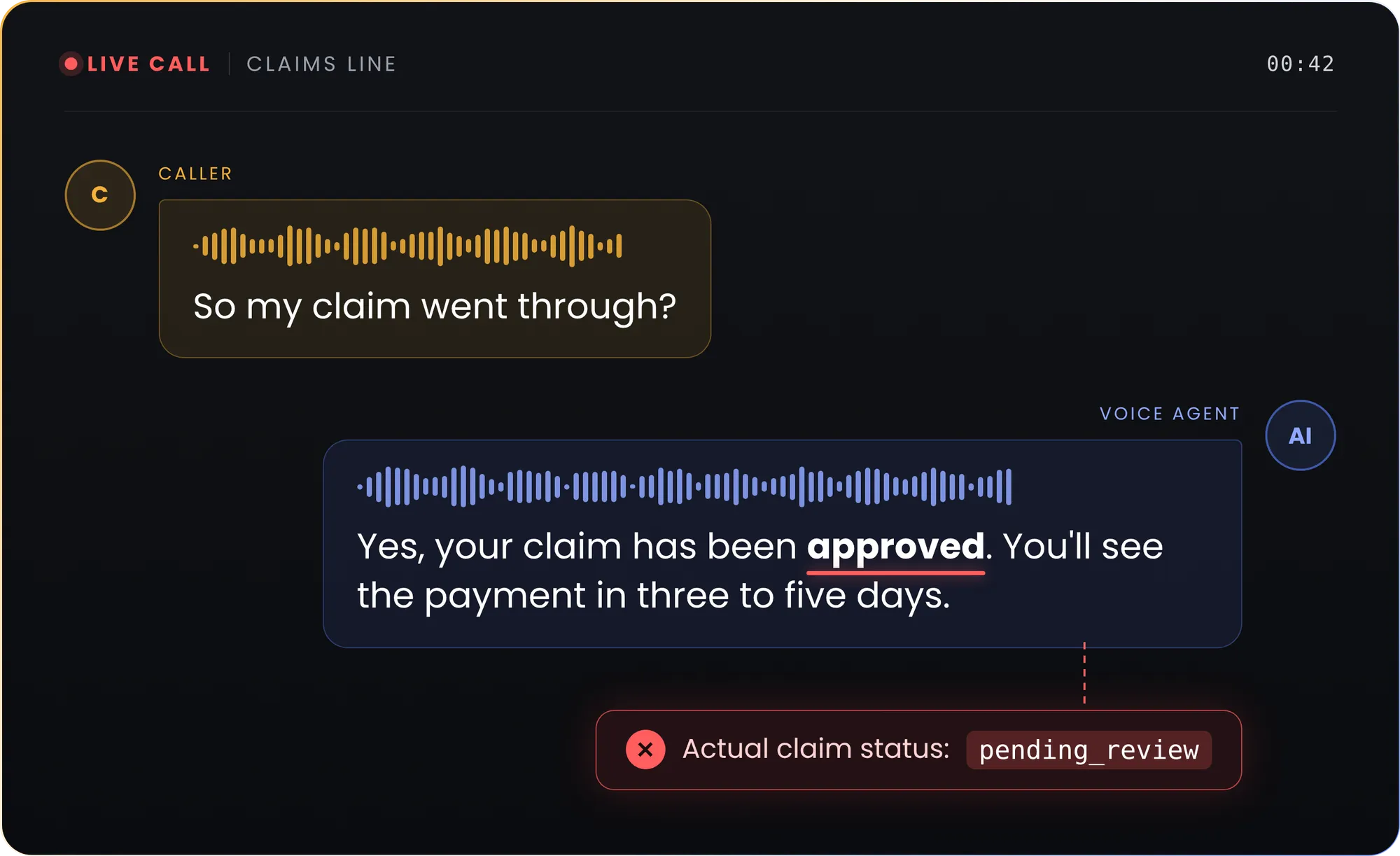
It hadn't been approved. It was still under review.
Rachel, who leads AI at a small insurance startup, heard about it from an angry customer. Her team runs a voice agent for claim calls, built on LiveKit, and a text agent for policy questions. She needed a testing tool fast, and Hamming AI was first on her list.
But first she needed to know where the bug actually was. The answer would decide which tool she bought. So let's work through it the way she did: one suspect at a time.
What Is Hamming AI, and Why Is Netra a Strong Alternative?
Hamming AI calls itself “the security layer for voice and chat agents”. It has three modules: RedSwarm for red teaming, GreenLoop for testing, and BlueTrace for production monitoring. Its strength is depth on the phone line: real telephony, keypad menus, and load tests at large scale.
Netra is an AI observability, evaluation, simulation, and security testing platform for text, voice, image, and video agents. It runs voice agent simulation with realistic personas, scores each call from the audio, and traces every call through the prompts, tools, and data behind it. Prompt versions and production insights sit in the same place, and you can start on a free plan. That makes it a strong alternative when the bug might not be on the phone line at all.
Why Do Teams Look for Hamming Alternatives?
It's rarely about quality. It's about the first step.
Getting started with Hamming takes a few steps. There’s no self-serve sign-up or free trial, so the first move is a demo, followed by a quote for one of its two plans, Production or Enterprise, based on your deployment. Even the docs sit behind an access code.
For an enterprise buyer, that's normal. For a team with a live bug and a deadline, it means a demo before a single test. Rachel booked the demo. She also kept looking.
Which Tool Would Have Caught the Bug? Five Suspects
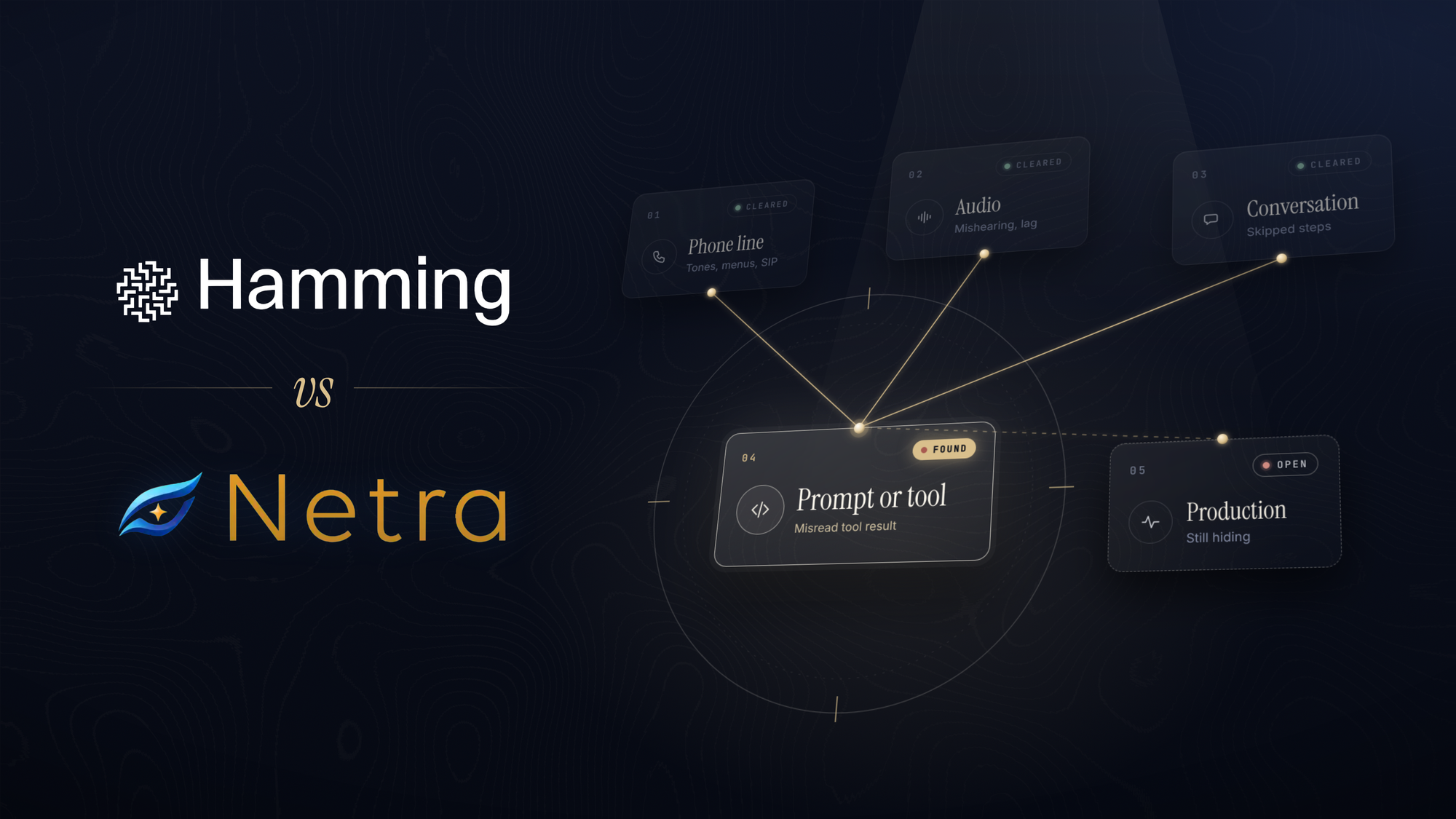
A voice agent can fail in five places. Each one is a suspect, and each favors a different tool.
Suspect 1: Was It the Phone Line?
Dropped keypad tones, broken phone menus, and bad SIP routing happen before the agent says a word. This is Hamming's home ground: it tests over PSTN, SIP and WebRTC, handles keypad tones (DTMF) and phone menus (IVR trees), and runs "50K+ concurrent calls in CI/CD". Netra connects to your agent directly through LiveKit or Vapi, so its tests focus on what happens once the call is connected.
Edge: Hamming. Rachel's call connected fine. Suspect cleared.
Suspect 2: Was It the Audio?
Maybe the agent misheard "under review", or lagged and talked over the caller.
Netra scores each simulated call from the audio itself, with voice evaluators such as word error rate, time to first transcript, pronunciation accuracy, and speaking percentage. The stereo recording sits next to the transcript and the trace, so you can hear the exact moment a turn went wrong. Hamming breaks latency down by speech-to-text, LLM, and text-to-speech, and covers 65+ languages.
Edge: Both strong. Rachel played the recording. Clean. Cleared.
Suspect 3: Was It the Conversation?
Did the agent skip a policy step or lose track of the call? Both tools run simulated calls to find out.
In Netra, you set up personas, background noise, turn limits and call length, then run the scenario. Session evaluators such as Goal Fulfillment, Guideline Adherence and Conversation Memory return a score, a plain-language reason and the exact turns that failed. You can compare runs side by side after each change. Hamming offers 50+ built-in metrics and reports 95%+ agreement with human reviewers, its own figure.
Edge: Both strong. Netra explains the "why" turn by turn. Rachel's agent followed every step. It just said the wrong thing with confidence. Cleared.
Suspect 4: Was It a Prompt or a Tool?
This is where most "the agent sounded fine but lied" bugs live, and where the two tools split.
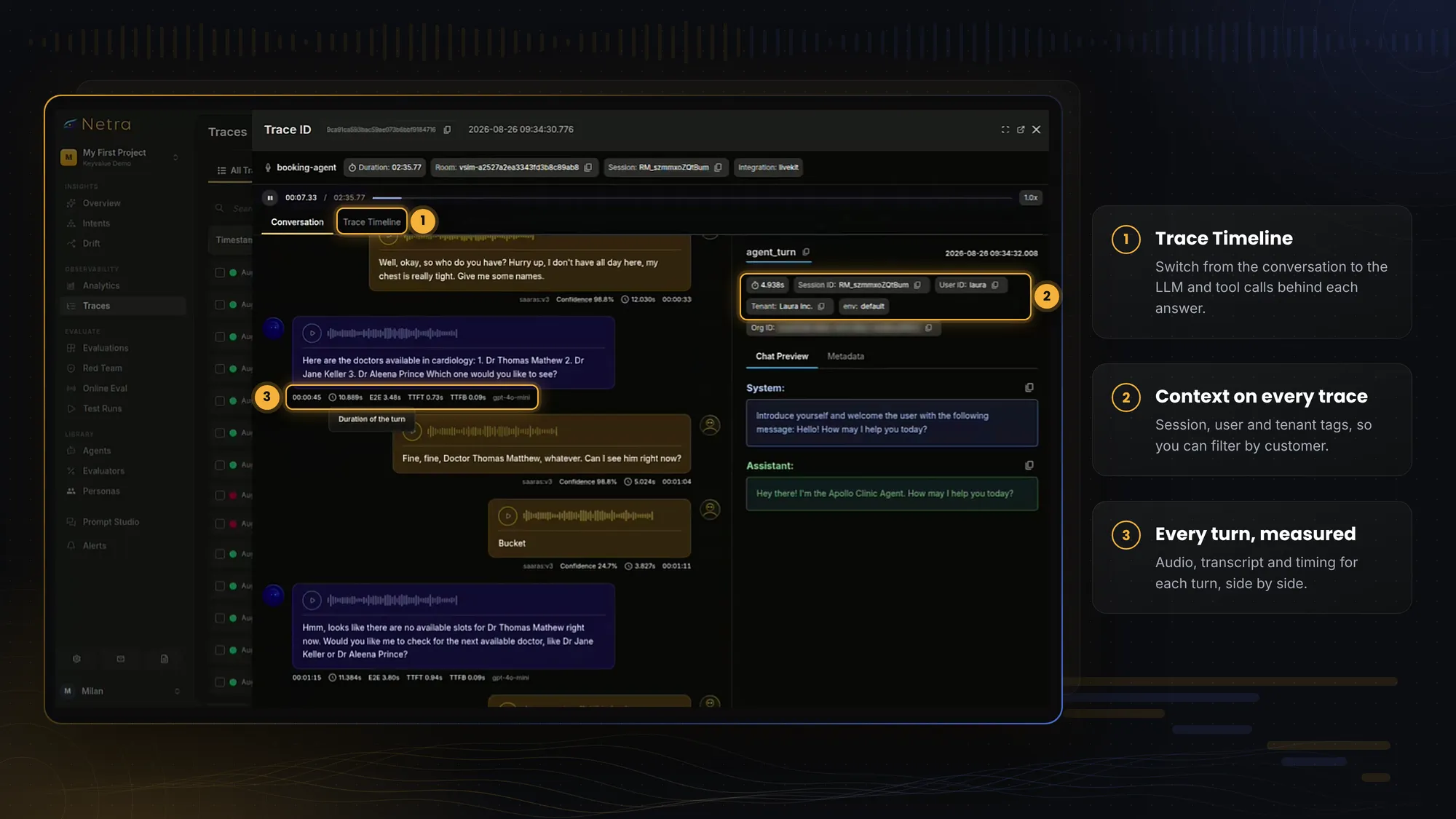
Hamming describes call metrics exported to OpenTelemetry. They don't describe tracing the rest of the stack or managing prompts. Netra does both:
- One trace, start to finish. Netra auto-instruments 14 LLM providers, popular agent frameworks, and 8 vector databases, and integrates with LiveKit and Vapi. A trace follows the caller's words to the tool call and the data behind it, for voice and text agents alike.
- Every prompt version is kept. Prompt Studio stores immutable versions with labels like production and staging, and shows GitHub-style diffs.
Netra trace for a LiveKit voice agent call, showing each turn's audio, transcript and timing, session, user and tenant tags, and the Trace Timeline tab for LLM and tool calls.
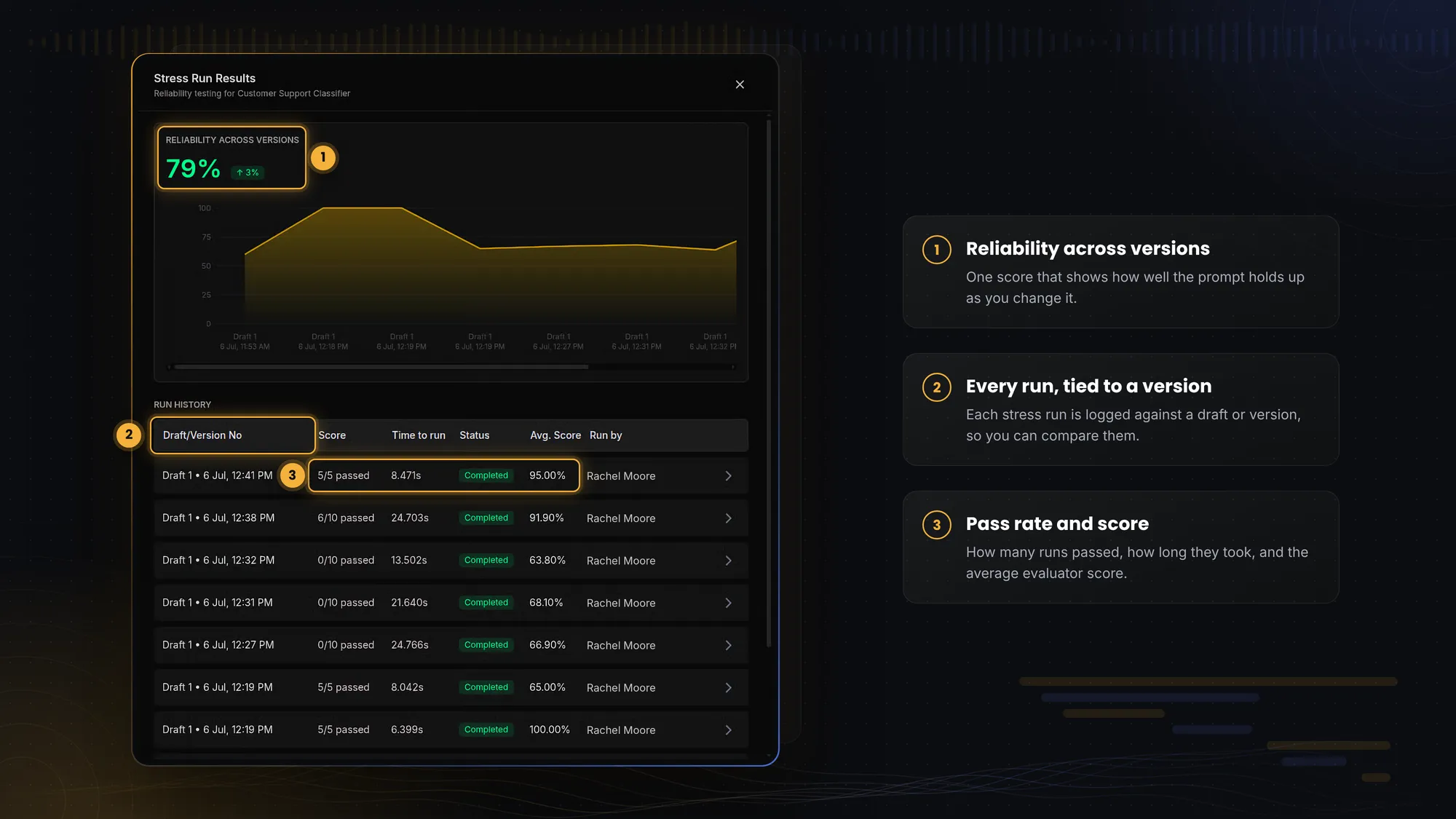
Rachel opened the trace. The claim-status tool returned "pending_review". A prompt edit from two weeks earlier had changed how the agent read that field. She compared the old and new prompt side by side, spotted the changed line, and switched production back to the old version. Before publishing a proper fix, she ran a stress test: the same prompt, run many times across several models, with every run scored by evaluators. In Run History, she compared the new draft against the published version before moving the label. The same edit had broken her text agent too. Nobody had noticed.
Edge: Netra. Suspect found.
Suspect 5: What Else Is Going Wrong in Production?
One bug found usually means others are hiding. Testing checks the calls you think of. Production shows the ones you didn't.
Hamming's BlueTrace monitors live calls for "drift, leaks, and broken promises". Netra looks through two other lenses:
- By intent. Agent Insights groups real traffic into intents after about 500 traces. It tracks cost, latency, step count, error rate, tool usage and output length for each one against a rolling 30-day baseline. You see "errors are up on claim-status questions", not just "errors are up".
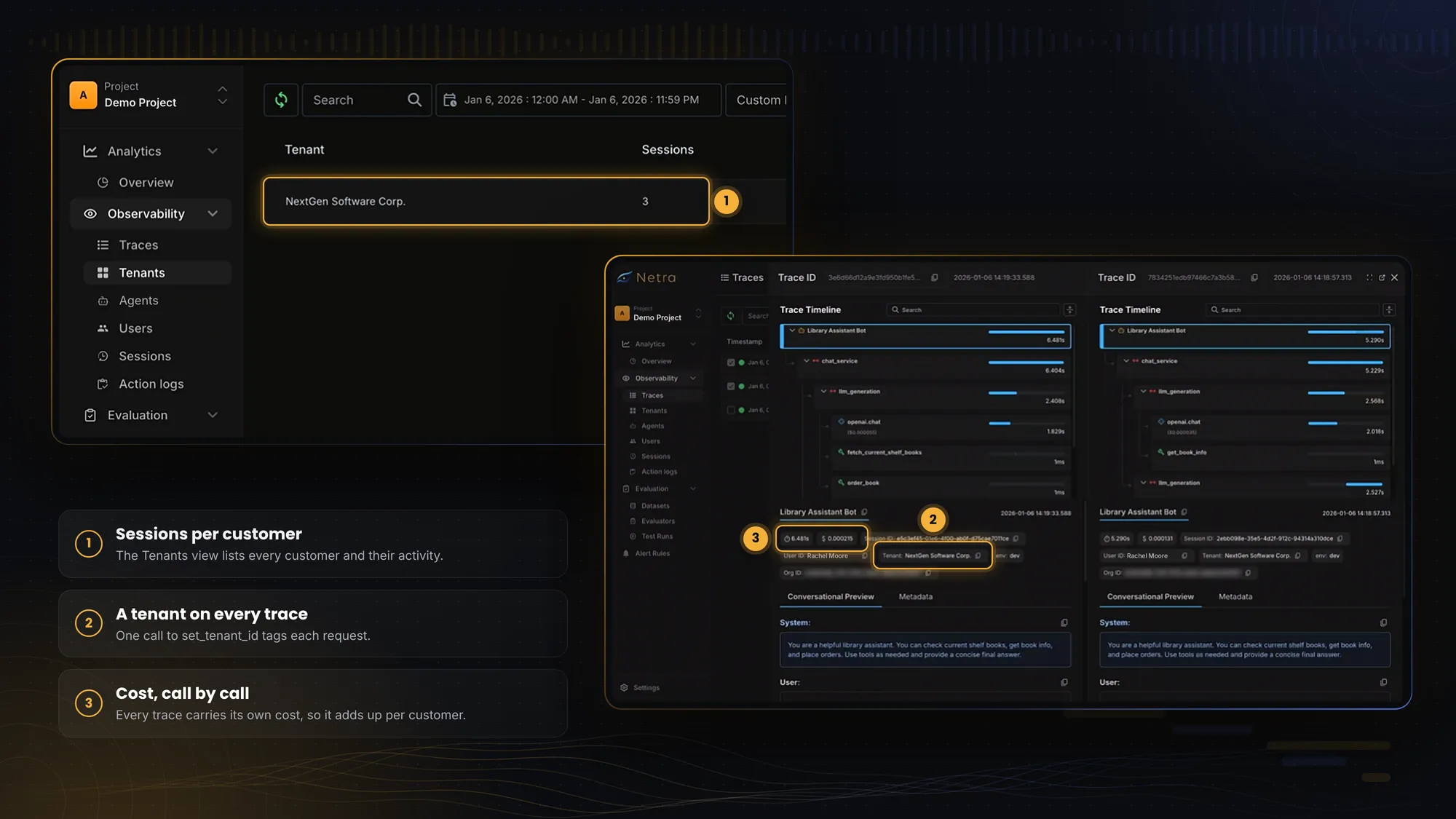
- By customer. One call to set_tenant_id tags each request, and the Tenants view shows cost, traces, and sessions per customer. Rachel's team sells white-label agents to brokers, so finance finally got its cost-per-broker answer.
Edge: Netra, when you need to know which intent or which customer is affected.
How Does Hamming AI Pricing Compare With Netra's?
Hamming quotes each deployment, mainly by test volume. Netra publishes its plans on its pricing page: Free (5,000 spans, 100 evaluator executions and 25 test runs a month), Pro at $39 a month, and Custom with on-premise deployment and SSO. For voice agent simulation at high volume, ask Netra for a quote and compare like-for-like.
Which One Fits Your Team? (A 5-Question Check)
Count your A's and B's.
- Where do your agents run? A: Phone menus, SIP trunks, keypad input. B: LiveKit or Vapi, plus text agents.
- What breaks most often? A: The call: audio, timing, telephony. B: What's behind it: prompts, tools, data.
- How do you want to start? A: A guided, sales-led rollout. B: Sign up and test today.
- How much load do you need? A: Tens of thousands of concurrent calls. B: Realistic scenarios on every change.
- Who reads the results? A: QA and security reviewers. B: The engineers who ship the fix.
Mostly A: Hamming. Mostly B: Netra. A mix: run the bake-off below.
For more, see how voice agent simulation works and our voice agent testing guide.
Case Closed: What Did Rachel Choose?
Netra. Her bug was in a prompt, not the phone line. She runs voice and text agents on one stack. And she ran her first test that afternoon.
If she'd been testing a bank's phone menu at tens of thousands of calls, Hamming would have been the smarter buy. That's the real lesson from comparing Hamming alternatives: don't buy the longest feature list. Buy the tool that can see where your agent breaks.
Start free with Netra, or talk to the team about your voice stack.
The short answer: Hamming AI calls itself "the security layer for voice and chat agents". Netra is an observability, evaluation, and simulation platform for text and voice agents. Among Hamming alternatives, Netra fits teams that want to start without a sales call and debug the whole agent, not just the call. Every Hamming fact links to Hamming's own pages, checked on 19 November 2026.
FAQs
1. What is the best Hamming alternative?
It depends on why you're leaving. For a self-serve start and one platform for text and voice agents, with tracing, prompt management, and insights, Netra is a strong fit. If you need deep telephony testing, such as SIP, IVR menus, or very large load tests, Hamming may still be the better choice. Test both on your own calls.
2. Does Hamming publish its pricing?
No. Hamming has two plans, Production and Enterprise, and both are "quoted for your deployment". Its FAQ says pricing is based mainly on test volume and there's no traditional self-serve free trial. Netra publishes its plans: Free, Pro at $39 a month, and Custom.
3. Does Hamming test chat agents?
Yes. Hamming's homepage says it "tests both voice and chat agents", so comparison pages describing it as voice-only are out of date. Netra covers text and voice agents too, and adds tracing, prompt management and production insights across both.
4. Do Hamming and Netra support SOC 2, HIPAA and GDPR?
Both list SOC 2 Type II, HIPAA, and GDPR. Hamming offers a BAA and a DPA, and its pricing page lists the SOC 2 report, HIPAA BAA, and data residency on Enterprise. Netra offers US or EU data residency on every plan. Ask either vendor for current reports before sending production data.
5. Can Netra test agents built on Retell or ElevenLabs?
Not today. Netra connects to voice agents built on LiveKit and Vapi. If your agent runs on Retell, ElevenLabs or Pipecat, Hamming currently covers more platforms. Check Netra's integration docs for updates.