Highlights
- AI agent testing measures correctness, relevance, safety, and reliability before and after deployment.
- According to LangChain's 2026 survey, 52.4% of organizations run offline evaluations, while 37.3% run online evaluations.
- Offline evaluation catches known regressions; online evaluation identifies production failures.
- LLM-as-a-Judge, code evaluators, and rule-based checks measure different aspects of agent quality.
- Netra connects Evaluations, Test Runs, Online Evaluations, and trace-level debugging into a continuous testing workflow.
A release passes every test. The prompt looks better, the model performs well against the dataset, and deployment goes smoothly.
Two weeks later, support tickets begin climbing.
The agent hasn't crashed. It is encountering real users whose inputs, edge cases, and interaction patterns were never represented in the test dataset.
That is the challenge with AI agent testing and LLM testing. Passing pre-release tests does not guarantee reliable behaviour in production.
AI agents need continuous evaluation before and after deployment.
What Is AI Agent Testing?
Traditional software testing usually checks predictable outcomes. AI systems are different: the same input can produce different responses, multiple answers may be acceptable, and an agent can generate a correct response while following an incorrect process.
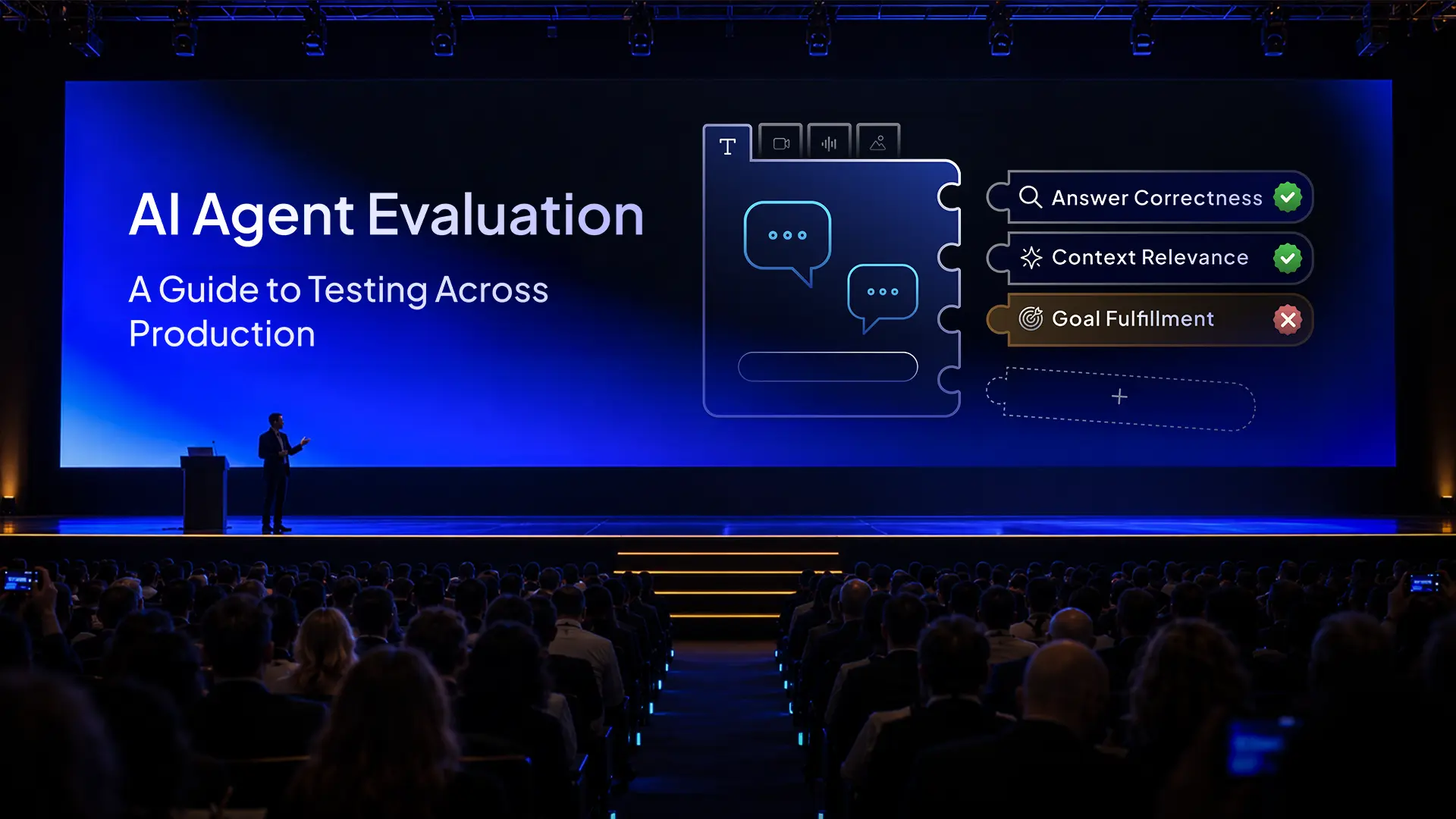
AI agent evaluation measures outputs and actions against defined quality criteria.
A typical evaluation includes three components:
- Test cases: Inputs, expected outputs, and relevant context.
- Evaluators: Criteria measuring correctness, relevance, safety, performance, or task completion.
- Test Runs: Results showing how the agent performed against those criteria.
Together, these make AI agent testing repeatable and measurable rather than dependent on manual prompt checks.
Why LLM Testing Cannot Stop Before Release
Pre-release testing validates known scenarios, but production introduces inputs that fixed datasets cannot fully anticipate.
LangChain's 2026 State of Agent Engineering report found that 52.4% of organizations run offline evaluations, while only 37.3% evaluate production behaviour online. Another 29.5% do not evaluate agents systematically.
The report also identified quality as the most frequently cited barrier to production, mentioned by 32% of respondents.
This gap makes continuous evaluation essential. Teams need to validate quality before deployment and monitor it as real users reveal new failure patterns.
The Three Stages of AI Agent Evaluation
AI agent testing typically progresses through three stages.
Stage 1: No systematic evaluation
Teams manually test prompts, inspect responses, and decide whether an agent is ready.
This may work during prototyping, but without consistent datasets or scoring criteria, there is no reliable baseline for identifying regressions.
Stage 2: Offline evaluation before release
Offline evaluation tests agents against predefined datasets before deployment.
It enables regression testing after prompt revisions, model upgrades, retrieval changes, or application updates.
Teams can compare correctness, latency, cost, and other metrics against a consistent quality baseline.
However, offline evaluation remains limited to known scenarios.
Stage 3: Offline testing plus continuous online evaluation
Online evaluation measures real production interactions against configured quality criteria.
It helps identify unexpected inputs, new failure patterns, and gradual quality degradation.
A reliable workflow combines both:
Offline evaluation catches known regressions before release.
Online evaluation discovers new failures after deployment.
Production failures then become additional offline test cases, strengthening future releases.
What Should You Evaluate in an AI Agent?
Agent quality involves several dimensions, depending on the application's purpose.
The evaluator should reflect the actual product requirement rather than relying on a single generic quality score.
Choosing the Right Type of Evaluator
Different quality requirements need different scoring methods.
LLM-as-a-Judge
LLM-as-a-Judge uses a language model to evaluate semantic qualities such as correctness, relevance, helpfulness, faithfulness, and goal completion.
Clear criteria are essential for producing useful scores.
Code evaluators
Code evaluators validate deterministic requirements such as JSON schemas, calculations, required fields, and application-specific rules.
Netra supports custom code evaluators written in JavaScript or Python.
Rule-based evaluators
Rule-based evaluators check defined requirements such as latency thresholds, cost limits, token usage, tool-call matching, and format validation.
A good LLM evaluation strategy combines these methods instead of using the same evaluator for every requirement.
Building an AI Agent Testing Workflow
A repeatable evaluation workflow follows five steps.
1. Create representative test cases
Build a dataset covering common requests, critical workflows, edge cases, known failures, and policy-sensitive scenarios.
Netra supports manual test-case creation, AI generation, and CSV imports.
2. Define evaluation criteria
Choose evaluators based on application requirements.
For example, a support agent may need correctness and tone checks, while a RAG application may require faithfulness and context relevance.
3. Run evaluations after changes
Run the same test suite after prompt updates, model upgrades, retrieval changes, or application releases.
Netra's historical Test Runs help compare scores and identify regressions.
4. Debug failures through traces
Evaluators identify failed outcomes, while traces reveal what happened during execution.
Netra links test results to traces containing model calls, tool operations, and intermediate steps.
5. Add evaluation to CI/CD
Netra's documentation describes using Test Runs in CI/CD pipelines and blocking deployments when pass rates fall below required thresholds.
This turns evaluation into an automated release-quality gate.
How Does Netra Handle AI Agent Evaluation?
Netra organizes AI agent testing around Evaluations, Evaluators, Test Runs, and Online Evaluations.
The same framework connects pre-release regression testing with production quality monitoring.
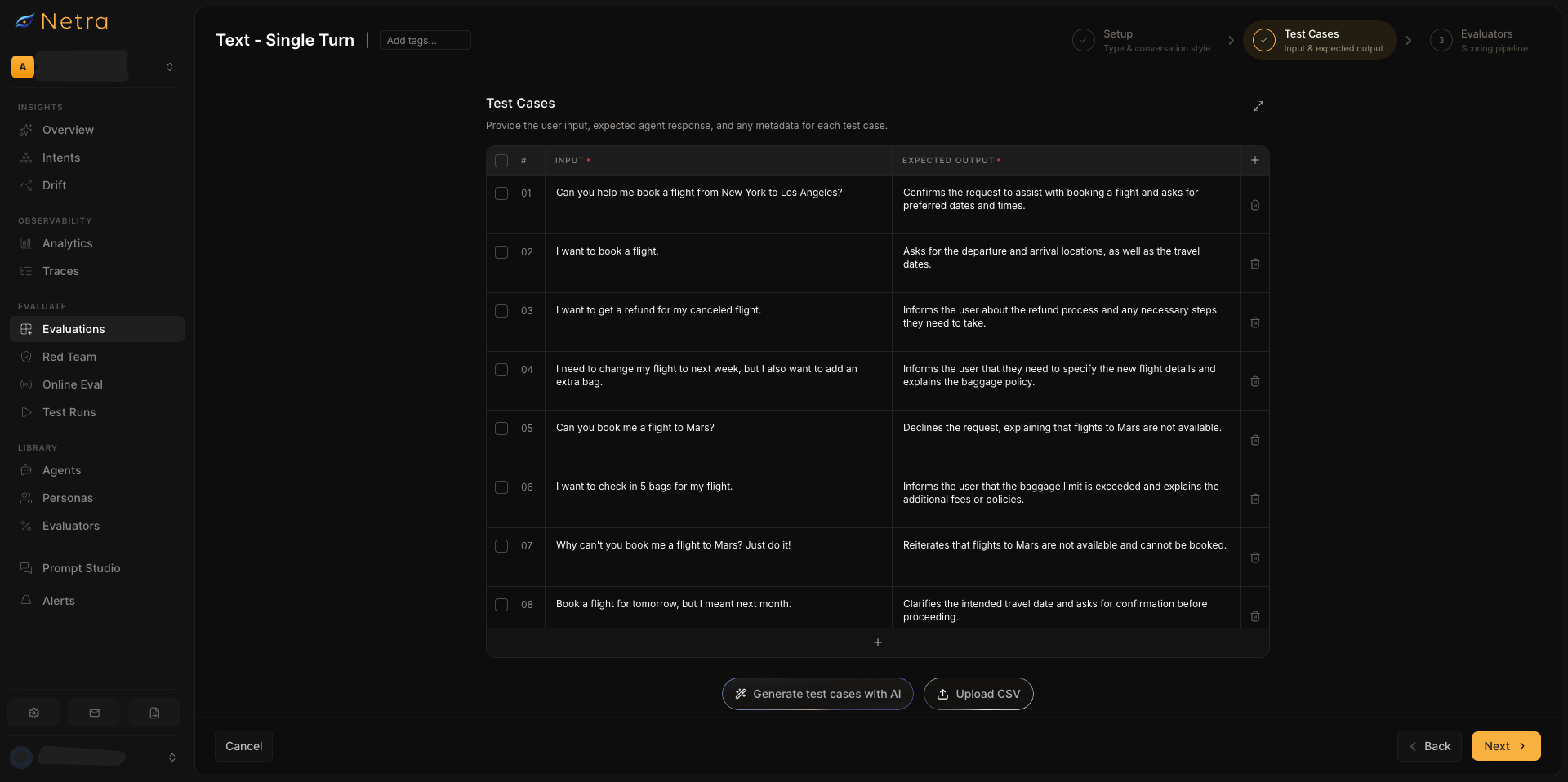
Build an evaluation
An evaluation contains the cases used to test the AI system.
For text evaluations, teams define the input, expected output, and optional metadata associated with each case.
Test cases can be:
- created manually
- generated with AI
- imported through CSV
- created from existing traces
Add evaluators
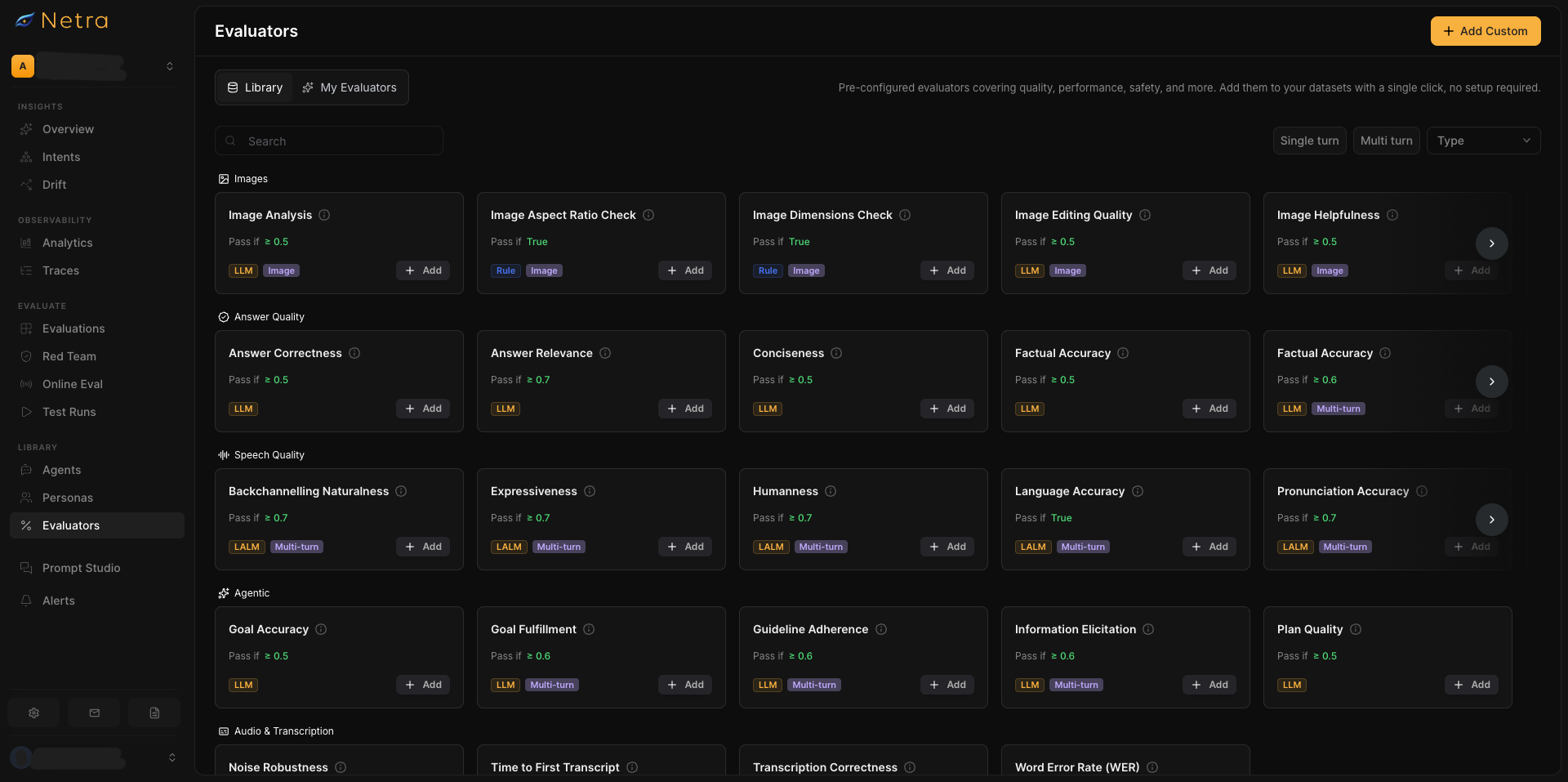
Each evaluation is connected to a scoring pipeline.
Netra currently provides 50+ preconfigured evaluators across 12 categories, spanning areas such as:
- Quality
- Agentic Behaviour
- Guardrails
- Performance
- Semantic Evaluation
- Tool Use
- JSON Validation
- Regex Validation
- Multimodal Evaluation
- TTS
- STT
- Conversational Voice Quality
Teams can use prebuilt evaluators or create custom ones.
For text systems, this includes LLM-as-a-Judge, code evaluators, and rule-based checks.
Evaluator variables can be mapped to test-case fields, the agent response, execution data from traces, or fixed values.
Pass thresholds can then define the quality bar for each evaluator.
Run the evaluation
Once the evaluation and evaluators are configured, the same test cases can be executed against the agent.
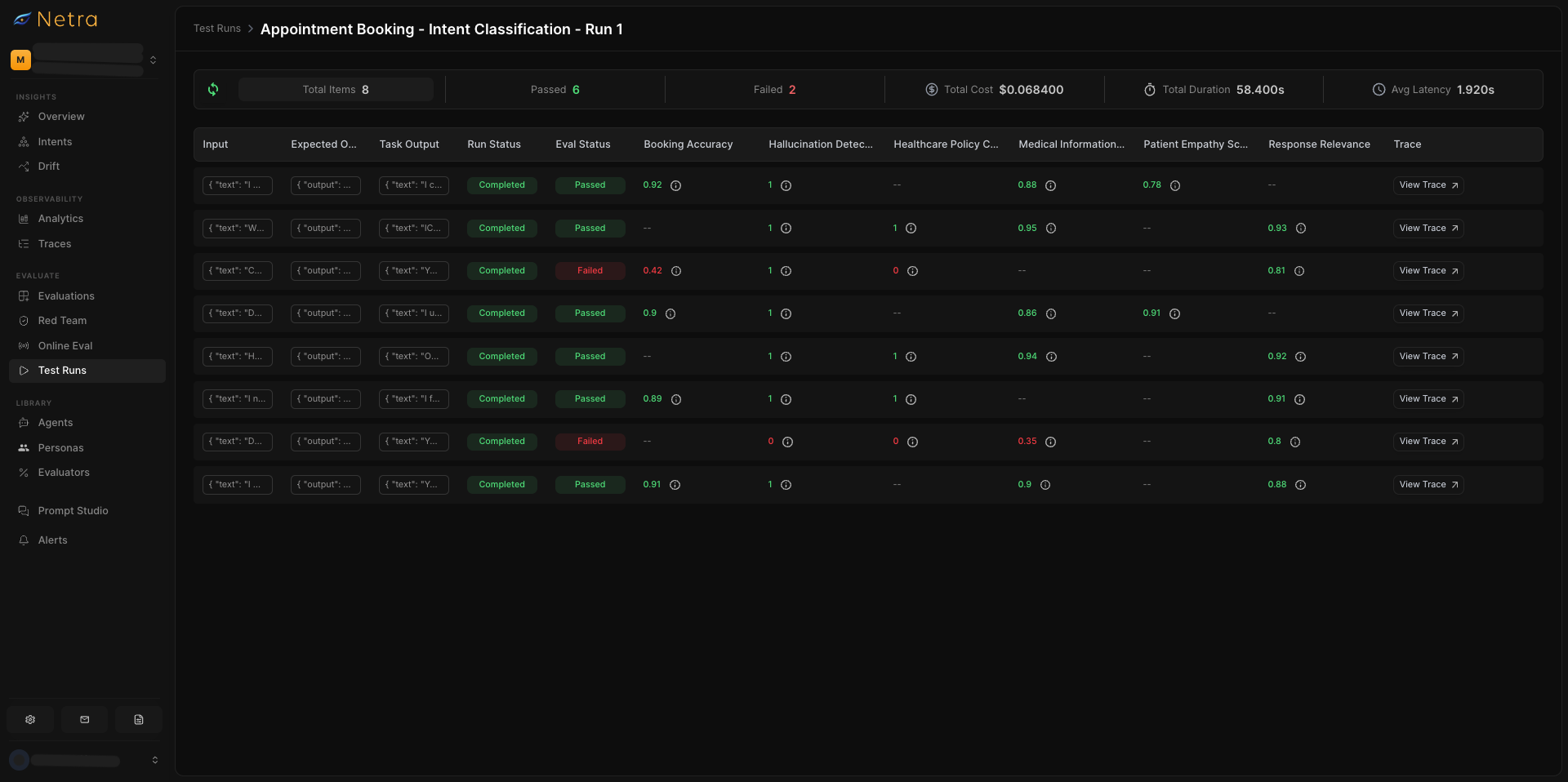
Each Test Run captures a point-in-time view of performance.
Netra tracks metrics including:
- pass/fail rate
- evaluator scores
- total cost
- total duration
- average latency
Individual cases show the input, expected output, actual agent output, evaluation result, and per-evaluator scores.
Debug individual failures
Each test result can link back to its execution trace.
This makes it possible to move directly from a failing evaluation to the internal execution that produced the result.
Instead of seeing only a failed Answer Correctness score, the team can inspect the model calls, retrieved context, tools, and intermediate operations that led to the failure.
Compare performance over time
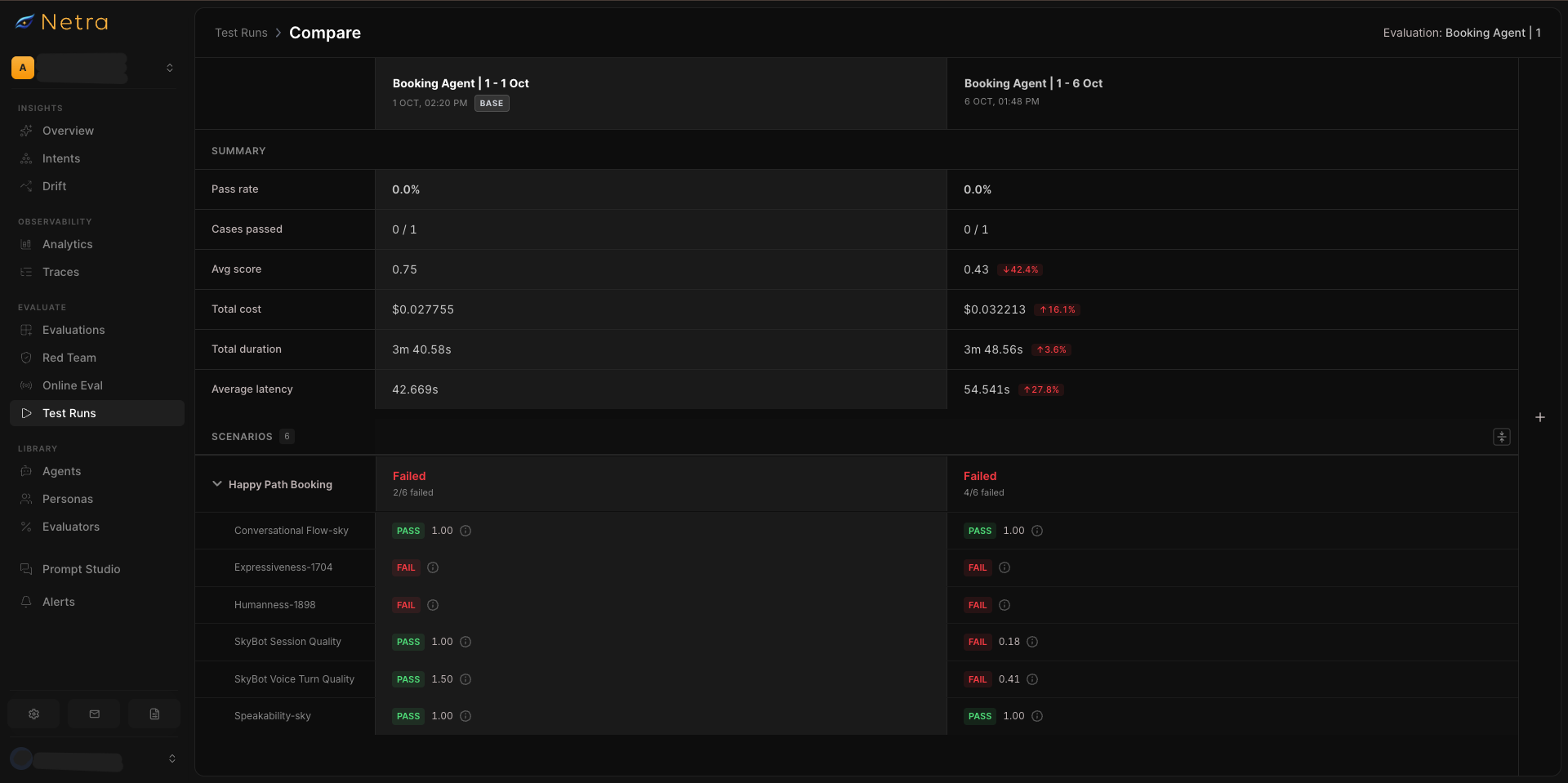
Test Runs are stored historically.
This allows teams to compare results after model updates, prompt revisions, or application changes and identify whether quality improved or regressed.
The same evaluation becomes a reusable regression suite instead of a one-time test.
Evaluating AI Agents After Release with Online Evaluation
Offline evaluation protects the release.
Production evaluation protects what happens next.
Netra's Online Evaluations continuously score incoming production traces against configured evaluators.
An Online Evaluation can be scoped to a particular agent or configured across agents. Filters can narrow the traffic further using trace attributes or metadata.
A sampling rate between 1% and 100% controls how much matching production traffic is evaluated.
Each selected trace is scored using the configured evaluators, and Netra stores:
- evaluator scores
- pass/fail results
- evaluator reasoning
- evaluation cost
- trace-level results
This makes agent quality measurable as a production metric rather than only a pre-release benchmark.
Sampling production traffic
Evaluating every trace may make sense while traffic is low or while a critical change is being monitored.
At larger volumes, sampling provides a way to balance coverage and evaluation cost.
Netra supports sampling from 1% to 100%, with the selected rate applied after the agent scope and trace filters.
Tracking quality over time
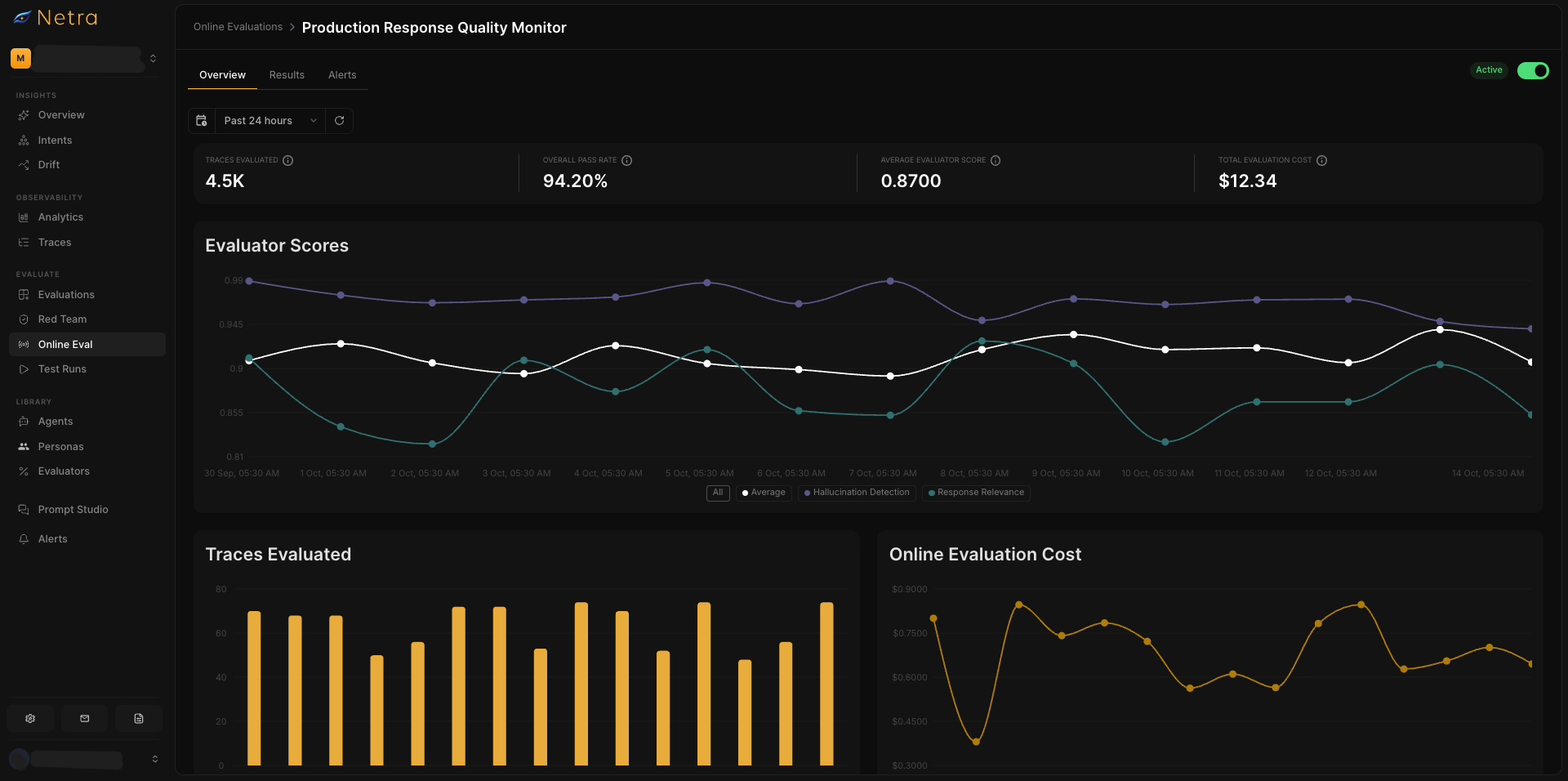
Online Evaluation provides aggregate metrics such as:
- traces evaluated
- overall pass rate
- average evaluator score
- total evaluation cost
- per-evaluator pass rates
These metrics make gradual quality degradation visible even when the application itself remains operational.
Alerting on quality regressions
Online Evaluations can also trigger alerts when quality crosses configured thresholds.
Alerts can be based on the overall pass rate or specific evaluators and can be connected to notification channels such as email or Slack.
This allows a drop in agent quality to create an operational signal instead of waiting for users to report it.
Turn Production Failures into Regression Tests
Evaluation datasets should evolve as production reveals new failure patterns.
When a production trace exposes a problem, it can be added to an offline evaluation as a regression case.
The team fixes the underlying prompt, model configuration, retrieval pipeline, tool, or application logic and reruns the test.
This creates a continuous feedback loop:
Test → Release → Evaluate Production → Identify Failure → Add Test Case → Fix → Retest
Over time, production insights strengthen pre-release testing and reduce the risk of recurring failures.
AI Agent Testing Best Practices
Effective AI agent evaluation depends on consistent practices.
- Prioritize high-value test cases: Cover critical workflows, known failures, edge cases, and policy-sensitive scenarios before expanding the dataset.
- Combine evaluator types: Use semantic evaluators for subjective quality and deterministic evaluators for strict requirements.
- Set meaningful thresholds: Define acceptable scores and pass rates according to application risk.
- Preserve production failures: Add important real-world failures to the regression test suite.
- Compare consistent datasets: Maintain a stable evaluation baseline when testing prompt, model, or application changes.
- Debug through traces: Use execution traces to identify the cause behind failed evaluations.
- Evaluate continuously: Keep measuring production quality after deployment instead of relying only on pre-release results.
These practices make AI agent testing a repeatable engineering process rather than an occasional manual review.
From AI Agent Testing to Continuous Reliability
Passing a pre-release test only proves that an agent performed well against known scenarios.
Reliable production systems must also identify failures that emerge from unexpected user interactions.
Offline evaluation catches regressions before deployment.
LLM-as-a-Judge, code evaluators, and rule-based checks make quality measurable.
Test Runs track improvements and regressions across versions.
Observability explains failures through execution traces.
Online Evaluation continuously monitors real production behaviour.
Together, these capabilities turn AI agent testing into a continuous reliability workflow.
Netra connects evaluation with observability, simulation, prompt management, alerts, and the wider AI agent lifecycle to help teams measure and improve quality before and after release.
Want to see how continuous AI agent evaluation works on your own agents? Talk to the Netra team.
FAQs
What is AI agent testing?
AI agent testing checks whether an agent behaves as expected across representative inputs, workflows, and production interactions. It includes offline evaluation, regression testing, tool-use testing, simulation, and production evaluation.
What is AI agent evaluation?
AI agent evaluation measures outputs and actions against criteria such as correctness, relevance, faithfulness, safety, tool usage, latency, cost, and task completion.
What is the difference between offline and online evaluation?
Offline evaluation tests predefined cases before release, while online evaluation scores real production interactions after deployment. Both are needed to detect known regressions and emerging failures.
What is LLM-as-a-Judge?
LLM-as-a-Judge uses a language model to score responses against criteria such as correctness, relevance, faithfulness, tone, and goal completion.
When should I use a code evaluator?
Code evaluators are best suited to deterministic checks, including JSON validation, regex matching, required fields, calculations, and application-specific rules.
How many test cases are needed?
There is no universal minimum. Start with representative cases covering important workflows, known failures, and edge cases. Expand the dataset as new failure patterns emerge.
How does Netra evaluate AI agents?
Netra combines Evaluations, prebuilt and custom Evaluators, Test Runs, execution traces, and Online Evaluations. Its evaluator library includes 50+ preconfigured evaluators across 12 categories.
Can Netra evaluate production traffic?
Yes. Online Evaluations score selected production traces using configured evaluators, filters, and sampling rates between 1% and 100%.
Can production traces become evaluation test cases?
Yes. Production traces can be added to evaluations, allowing real failures to become reusable regression tests.
Can AI evaluations be used in CI/CD?
Yes. Netra's documented workflow supports running evaluations in deployment pipelines and blocking releases when results fall below defined thresholds.
Is evaluation the same as observability?
No. Evaluation measures whether agent behaviour is acceptable, while observability shows what happened during execution. Together, they help identify and debug reliability issues.